The Premium Category offers an exclusive experience, including:
The best available seats within the Optima Category
A contribution in support of the Opera
A program of the event
A glass of champagne
Synopsis
Act 1:
Since his wife’s death, the Bailiff has lived alone with his nine children. Charlotte, the eldest, manages the household. Although the scene takes place during the month of July, the Bailiff is teaching his youngest offspring to sing a Christmas carol – much to the amusement of his friends Schmidt and Johann. Relatives and friends arrive to take Charlotte to a ball in the country. Among them is Werther – a sensitive, solitary, melancholic, nature-loving artist – a stranger to the little town. Werther watches Charlotte as she takes care of her younger brothers and sisters and falls under her spell. Charlotte asks her sister Sophie to watch over father and children and leaves the house accompanied by Werther. Albert, Charlotte’s fiancé, returns unexpectedly from a long journey. He is disappointed not to find Charlotte but Sophie assures him that everyone is excited about his upcoming marriage to her sister. Later that evening, Werther escorts Charlotte home. In the garden, under the moonlight, he professes his love for her. Charlotte feels attracted to the sensitive young man. However, when the Bailiff announces Albert’s return, Werther learns that Charlotte has promised her dying mother to marry the latter. Despite his despair, Werther swears to be true to his word.
Act 2:
It is autumn and the villagers prepare to celebrate the minister’s golden wedding. The guests include Albert and Charlotte who have now been married for three months and Werther who is still in the grip of his passion for Charlotte. Albert, who has suspicions about Werther’s feelings for his wife, tries to turn the young man’s attentions towards Sophie. But Werther, eager to have a discrete tête‑à‑tête with Charlotte, reminds her of their first romantic encounter. Disconcerted, the young woman begs him to go away for a while and to not return before Christmas. In his solitude, Werther gives free rein to his despair. The idea of suicide begins to dawn in his mind. He announces to Sophie, who has come to invite him to join in the festivities, that he is leaving forever. Albert is now certain that Werther loves Charlotte.
Act 3:
It is Christmas Eve. Charlotte is alone at home rereading the letters that Werther has sent her since his self-imposed exile. Sophie arrives and immediately discerns her elder sister’s sadness and distress. She tries to cheer Charlotte up before returning to her father and siblings. Charlotte drifts back into despair. Werther, lacking the will to hold to his promise to never see Charlotte again, comes to visit her in her husband’s house. They remember the happy times they spent together making music and reading the works of great poets. The vivid evocation of some verses by Ossian rekindles the suffering of their impossible passion. For a brief moment, Charlotte’s true feelings shine through. Yet once again, duty triumphs: when Werther tries to kiss her, she resists and dashes out. Werther sees no point in living anymore and leaves the house. Albert returns from his travels. He knows that Werther has returned and he questions his wife, who is unable to conceal her distress. A messenger brings a letter from Werther. In it, Werther announces that he is going on a long journey and asks Albert to lend him his pistols. The latter orders Charlotte to hand over the guns to the messenger.
Act 4:
Seized by dark foreboding, Charlotte rushes to Werther’s home but she arrives too late; the young man has fatally wounded himself. He asks her not to go in search of help, preferring to die in her arms. Charlotte finally admits her love for him and returns his kiss. Outside, in the distance, the children can be heard singing the Christmas carol they learned during the summer. In his agony, Werther takes the singing as a sign of divine redemption. He dies asking Charlotte to weep over his grave.
CHARACTERS
The bailiff: Bailiff of Wetzlar, a widower and father of nine children, including Charlotte and Sophie.
Charlotte: The bailiff’s eldest daughter.
Sophie: Charlotte’s younger sister.
Werther: A young diplomat, new to the town, enamoured of poetry and nature.
Albert: The fiancé (and later the husband) of Charlotte.
Schmidt and Johann: Friends of the bailiff.
Brühlmann: A young man from the village.
Kätchen: Brühlmann’s fiancée.
Cast
Drame lyrique in four acts and five scenes (1892)
After Johann Wolfgang von Goethe
Language : French
Surtitle : French / English
Duration : 2h50 with 1 interval
First part: 75 min
Intermission: 30 min
Second part: 65 min
Creative team
Jules Massenet: Music(1842-1912)
Édouard Blau, Paul Millet et Georges Hartmann: Libretto
Nathalie Stutzmann: Conductor
Robert Carsen: Director
Radu Boruzescu: Set design
Luis F. Carvalho: Costume design
Peter Van Praet: Lighting design
Marco Berriel: Choreography
Cast
Benjamin Bernheim: Werther(11 > 20 Feb.)
Michael Spyres: Werther(22 Feb. > 12 March)
Aigul Akhmetshina: Charlotte
Gordon Bintner: Albert
Sandra Hamaoui: Sophie(11 Feb. > 2 March)
Johanna Wallroth: Sophie(6 > 12 March)
Laurent Naouri: Le Bailli
Christophe Mortagne: Schmidt
Franck Leguérinel: Johann
The Paris Opera Orchestra
ADO / The Paris Opera's Youth Choir
A coproduction with the Festspielhaus Baden-Baden
Venue
Paris Opera Bastille
RM Europa Ticket GmbH is an officially accredited ticket reseller of/by Opera National de Paris.
Agency number: 4848428
Opéra Bastille
A great modern theatre
The Opéra Bastille is the work of the Canadian-Uruguayan architect Carlos Ott, who was chosen in November 1983 after an international competition that attracted entries from some 1,700 architects. The theatre was inaugurated on July 13th 1989.
Its architecture is marked by transparent façades and by the use of identical materials for both the interiors and the exteriors.
With its 2,700 acoustically consistent seats, its unique stage facilities, its integrated scenery, costume and accessory workshops, as well as its numerous work areas and rehearsal rooms, the Opera Bastille is a great modern theatre.
Stage facilities
Orchestra pit, mobile and adjustable, can be covered; at its largest it can house 130 musicians
Main stage, 45 m high, 30 m wide, 25 m deep, made up of 9 elevators allowing several levels to be created and supported by three main elevators, which bring scenery up from below stage
Clearing zones, 4 storage areas with the same dimensions as the stage
Backstage area, with its scenery turntable
Circulation area, scenery temporarily stored between the stage, workshops and rehearsal stage
Rehearsal stage, the Salle Gounod, with its orchestra pit and dimensions identical to those of the main stage
The building
Area at ground level: 22,000 m²
Floor area: 160,000 m²
Total height: 80 m (including 30 m below street level)
The auditoriums
The main auditorium
Area: 1,200 m², 5% of the total for the building
Dimensions: 20 m high, 32 m deep, 40 m wide
Number of seats: 2,703
Materials: blue granite from Lannelin in Brittany, pearwood from China, glass ceiling
The amphitheatre
Area: 700 m²
Depth : 21.4 m
Number of seats : 450
Materials: white breccia marble from Verona, staff ceiling
The Studio
Area: 280 m²
Depth: 19,5 m
Number of seats: 237
Materials: white breccia marble from Verona and pearwood
Gift someone an unforgettable night at the opera. Choose a gift coupon and let them pick the performance they love—music, drama, and world-class artistry, all in one elegant experience.
 en
en 
 de
de it
it fr
fr es
es ru
ru jp
jp ro
ro








 Paris Opera Bastille
 Thu 11 Feb 2027 - Fri 12 Mar 2027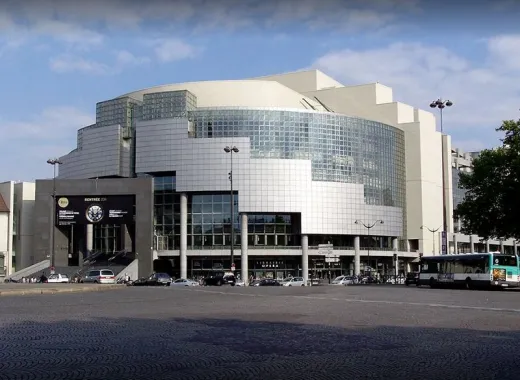



 RM EUROPA TICKET GmbH
 Call now
 Book now