The Premium Category offers an exclusive experience, including:
The best available seats within the Optima Category
A contribution in support of the Opera
A program of the event
A glass of champagne
Synopsis
First part
Act 1
Locked in a loveless marriage with Zinoviy Borisovich, Katerina feels dispirited. Her father-in-law, Boris Timofeyevich, who runs an industrial slaughterhouse, reproaches her for failing to provide his son with an heir after four years of marriage. Katerina holds her husband responsible for their childless union. When her husband is obliged to leave for a few days to resolve an unexpected work‑related issue, Boris Timofeyevich compels Katerina to swear before all the workers that she will remain faithful to her spouse. Aksinya, a young woman in the family’s service, evokes the reputation of the newly-hired Sergei: he’s a handsome fellow but also an inveterate womaniser.
He was forced to leave his last place of employment after he tried to seduce the mistress of the household. A group of workers, led by Sergei, harass Aksinya. Katerina intervenes and chastises the men for their disrespectful behaviour. Sergei challenges her to wrestle with him. Katerina accepts, but soon has to concede defeat. Just then, her father-in-law unexpectedly appears. Katerina invents a story to dispel any suspicion surrounding her and Sergei. Alone in her room, Katerina voices her frustrations: she yearns to be loved and desired. Her father-in-law advises her to go to sleep rather than burn the candle unnecessarily. However, someone knocks at the door: it is Sergei who pretends to have come to borrow a book. His true intentions, though, are all too obvious and, after some resistance, Katerina abandons herself to him.
Act 2
Suffering from insomnia, Boris looks back nostalgically on the excesses of his youth. Suddenly, he sees Sergei climbing out of Katerina’s bedroom window. He catches him and wakes everyone with his yelling. He demands that a whip be fetched and gives Sergei a severe beating. Powerless, Katerina is obliged to witness the scene. Boris locks up Sergei and orders Katerina to prepare him a meal since all the whipping has made him hungry. She goes and makes the mushroom dish that she usually prepares for him and laces it with rat poison. Soon thereafter, the old man goes into convulsions. Ignoring his cries, Katerina takes the keys to the warehouse where Boris locked up Sergei and leaves.
In the morning, the workers find Boris at death’s door and summon the priest. In his death throes, the old man accuses his daughter-in-law of having poisoned him, however, the priest does not understand his mutterings. Katerina feigns affliction. Katerina shares the conjugal bed with Sergei. The latter is troubled because he knows Zinoviy will soon return home. Katerina reassures him and tells him he has nothing to fear: he will be her husband. Her only cause for trepidation is Boris’s ghost, who appears in her bedroom every night to curse her. Not long after, Zinoviy returns home without warning. Sergei barely has time to hide. Zinoviy has heard what happened in his absence and he questions Katerina. She denies any involvement until Zinoviy beats her with Sergei’s belt. The latter comes to her aid and while he immobilises Zinoviy, Katerina strangles him. They then hide the body in the food cellar.
Second part
Act 3
Zinoviy is missing and presumed dead. Katerina and Sergei are getting married. Katerina is tormented by remorse. However, Sergei reproaches her for being so anxious at a time when everyone is preparing to celebrate. In a cabaret number, the shabby peasant suggests that Zinoviy’s corpse might be located nearby.
The police officers are also happily participating in the festivities. Most of the guests are now inebriated. Suddenly, Katerina realises that the body has been discovered. She warns Sergei, but the latter is reluctant to flee and abandon all the wealth now within his reach. When he finally agrees to take flight, it is too late: the police intervene. Unable to control herself, Katerina confesses and the two accomplices are arrested.
Act 4
Sergei and Katerina along with a group of other convicts are on their way to a prison camp. Sergei no longer wants anything to do with Katerina: he blames her for having destroyed his life. He tries to seduce Sonietka, a young prisoner. In exchange for her favours, she asks him to find her a pair of stockings. Sergei goes to see Katerina and, after claiming to have been injured by his shackles, he manages to convince her to let him have her stockings to make a bandage. However, Katerina soon realises that she has been duped.
The other prisoners mock her. Adding insult to injury, Sonietka offers her cynical thanks for the stockings. The prisoners arrive at a bridge. Katerina approaches Sonietka, pushes her into the river and jumps into the water after her. The two women drown. The convoy resumes its journey.
CHARACTERS
Boris Timofeyevich Izmailov: Owner of an industrial slaughterhouse
Zinoviy Borisovich Izmailov: Son of Boris and heir to the business
Katerina Lvovna Ismailova: Zinoviy’s wife
Sergei: An employee of the Izmailovs and Katerina’s lover
Aksinya: A young girl in the Izmailovs’ service
A shabby peasant: A worker in the Izmailovs’ service who is drunk most of the time
The orthodox priest
The police commissioner
Sonietka: A young prisoner
Cast
Opera in four acts and nine parts (1934)
After Nikolaï Leskov
Language : Russian
Duration : 3h25 with 1 interval
First part: 105 min
Intermission: 30 min
Second part: 70 min
Creative team
Dmitri Chostakovitch: Music(1906‑1975)
Alexander Preis, Dmitri Chostakovitch: Libretto
Ingo Metzmacher: Conductor
Ching-Lien Wu: Chorus master
Krzysztof Warlikowski: Director
Małgorzata Szczęśniak: Set design and costume design
Felice Ross: Lighting design
Denis Guéguin: Video
Claude Bardouil: Choreography
Christian Longchamp: Dramaturgy
Cast
Aušrinė Stundytė: Katerina Lvovna Ismailova
Pavel Černoch: Sergueï
Dmitry Ulyanov: Boris Timofeevich Ismailov
Oleksiy Palchykov: Zinovy Borisovich Ismailov
Ekaterina Sannikova: Aksinia
Marcel Beekman: Seedy Lout
Victoria Karkacheva: Sonietka
Michael Colvin: Teacher
Margarita Polonskaya: Female Convict
Dmitry Belosselskiy: Police Sergeant, Old Convict
Vartan Gabrielian: An officer
The Paris Opera Orchestra and Chorus
Venue
Paris Opera Bastille
RM Europa Ticket GmbH is an officially accredited ticket reseller of/by Opera National de Paris.
Agency number: 4848428
Opéra Bastille
A great modern theatre
The Opéra Bastille is the work of the Canadian-Uruguayan architect Carlos Ott, who was chosen in November 1983 after an international competition that attracted entries from some 1,700 architects. The theatre was inaugurated on July 13th 1989.
Its architecture is marked by transparent façades and by the use of identical materials for both the interiors and the exteriors.
With its 2,700 acoustically consistent seats, its unique stage facilities, its integrated scenery, costume and accessory workshops, as well as its numerous work areas and rehearsal rooms, the Opera Bastille is a great modern theatre.
Stage facilities
Orchestra pit, mobile and adjustable, can be covered; at its largest it can house 130 musicians
Main stage, 45 m high, 30 m wide, 25 m deep, made up of 9 elevators allowing several levels to be created and supported by three main elevators, which bring scenery up from below stage
Clearing zones, 4 storage areas with the same dimensions as the stage
Backstage area, with its scenery turntable
Circulation area, scenery temporarily stored between the stage, workshops and rehearsal stage
Rehearsal stage, the Salle Gounod, with its orchestra pit and dimensions identical to those of the main stage
The building
Area at ground level: 22,000 m²
Floor area: 160,000 m²
Total height: 80 m (including 30 m below street level)
The auditoriums
The main auditorium
Area: 1,200 m², 5% of the total for the building
Dimensions: 20 m high, 32 m deep, 40 m wide
Number of seats: 2,703
Materials: blue granite from Lannelin in Brittany, pearwood from China, glass ceiling
The amphitheatre
Area: 700 m²
Depth : 21.4 m
Number of seats : 450
Materials: white breccia marble from Verona, staff ceiling
The Studio
Area: 280 m²
Depth: 19,5 m
Number of seats: 237
Materials: white breccia marble from Verona and pearwood
Gift someone an unforgettable night at the opera. Choose a gift coupon and let them pick the performance they love—music, drama, and world-class artistry, all in one elegant experience.
 en
en 
 de
de it
it fr
fr es
es ru
ru jp
jp ro
ro







 Paris Opera Bastille
 Sat 13 Mar 2027 - Sun 28 Mar 2027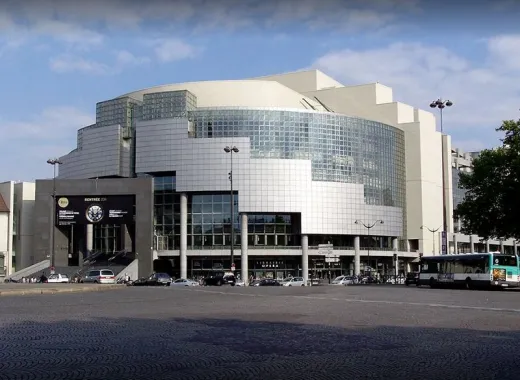



 RM EUROPA TICKET GmbH
 Call now
 Book now