
 EN
EN DE
DE IT
IT FR
FR ES
ES RU
RU JP
JP RO
RO
© Svetlana Loboff / OnP
Raymonda
Order tickets
June 2027  | ||||||
|---|---|---|---|---|---|---|
Mo | Tu | We | Th | Fr | Sa | Su |
The Premium Category offers an exclusive experience, including:
The best available seats within the Optima Category
A contribution in support of the Opera
A program of the event
A glass of champagne
Synopsis
First part
The action takes place in a castle in Provence during the 13th century where fair ladies and damsels temper the torments of solitude by listening to the songs of troubadours while awaiting the return of their valiant husbands and fiancés who left to fight in the Holy Land.
Act 1
At the castle, preparations are underway for a wedding. The Countess of Doris, who has no sons, is anxious to keep the family’s fortune and property in good hands and plans to marry her niece Raymonda to Count Jean de Brienne. Raymonda’s friends Henriette and Clémence fool around with the wedding dress with Béranger and Bernard.
The countess of Doris reproaches the youngsters for their frivolity whilst there is an army of Saracens at the gates of the city. She tells them of the White Lady whose ghost has long haunted the castle: whenever danger threatens, she comes from the netherworld to protect the House of Doris but she can also punish those who neglect their duty and their honour.
The seneschal announces the arrival of the King of Hungary. The latter carries a message from his friend and a fellow crusader, Jean de Brienne. The King hands Raymonda the letter from the Knight Jean de Brienne (in which the latter announces his imminent arrival) and gives the young maiden the gifts that her fiancé whom she has yet to meet has sent her. The gifts include a beautiful tapestry depicting the knight. Everyone dances. The graceful gestures of the ladies are countered by the masculine assurance of the warriors. Universal rejoicing.
Raymonda joins her friends: Henriette, Clémence, Béranger and Bernard. The arrival of an unexpected guest: the leader of the Saracens appears at the castle and presents Raymonda with sumptuous jewels and then withdraws. The Lords and ladies in attendance also take their leave. An ever-pensive Raymonda strums a few notes on her lute. Her friends try to amuse her. The young girl twirls her wedding veil. Henriette, Clémence, Béranger and Bernard let Raymonda rest.
With a melancholy air she bids farewell to her life as an innocent young girl and falls asleep. In her dream, Raymonda sees the White Lady who leads her towards the tapestry depicting the knight. Suddenly, the Knight comes to life. Romantic duo featuring Jean de Brienne and Raymonda, along with the vision of Henriette and Clémence and all the Lords and Ladies of the court. The dream is clouded by the sudden intrusion of the Saracen leader who seems to have taken the place of Jean de Brienne. Abderam renews his advances with added ardour. Raymonda tries to resist him but the foreigner becomes insistent, even violent. Henriette, Clémence, Béranger and Bernard awaken Raymonda, who is still reeling in terror from her nightmare. Her fears are assuaged as she returns to the real world.
Second part
Act 2
Abderam invites the gathered nobles to attend a divertissement which he intends to have performed in Raymonda’s honour. He sets the stage by erecting a giant tent. Abderam pays tribute to the young girl in the company of her friends Henriette, Clémence, Béranger and Bernard. The dance begins. Abderam leads his entourage of Arabs and Spaniards who are gathered in his camp.
In the midst of the general confusion, Abderam tries to abduct Raymonda. The valiant knight arrives just in time to save his fiancée: Jean de Brienne challenges Abderam. The King commands them to settle their differences by duelling in an impartial tournament. The two warriors compete on horseback in a jousting contest and then dismount for a swordfight in which Jean de Brienne fatally wounds Abderam. While the Saracens carry away their dying leader Jean de Brienne and his crusaders dance in victory. Jean de Brienne and Raymonda are reunited at last.
Third part
Act 3
All celebrate the marriage of Jean de Brienne and Raymonda. The presence of the King of Hungary in the Provençal castle gives rise to a grand divertissement set to a selection of Magyar songs.
Program and cast
Ballet in three acts
Scenario after Lydie Paschkoff and Marius Petipa
Duration : 3h05 with 2 intervals
First part: 75 min
Intermission: 20 min
Second part: 40 min
Intermission: 20 min
Third part: 30 min
Creative team
Rudolf Noureev: Choreographyand director, after Marius Petipa
Alexandre Glazounov: Music(1865-1936)
Vello Pähn: Conductor
Nicholas Georgiadis: Set design and costume design
With the Paris Opera Étoiles, First Soloists and Corps de Ballet
With the Paris Opera Orchestra
Paris Opera Bastille
RM Europa Ticket GmbH is an officially accredited ticket reseller of/by Opera National de Paris.
Agency number: 4848428
Opéra Bastille
A great modern theatre
The Opéra Bastille is the work of the Canadian-Uruguayan architect Carlos Ott, who was chosen in November 1983 after an international competition that attracted entries from some 1,700 architects. The theatre was inaugurated on July 13th 1989.
Its architecture is marked by transparent façades and by the use of identical materials for both the interiors and the exteriors.
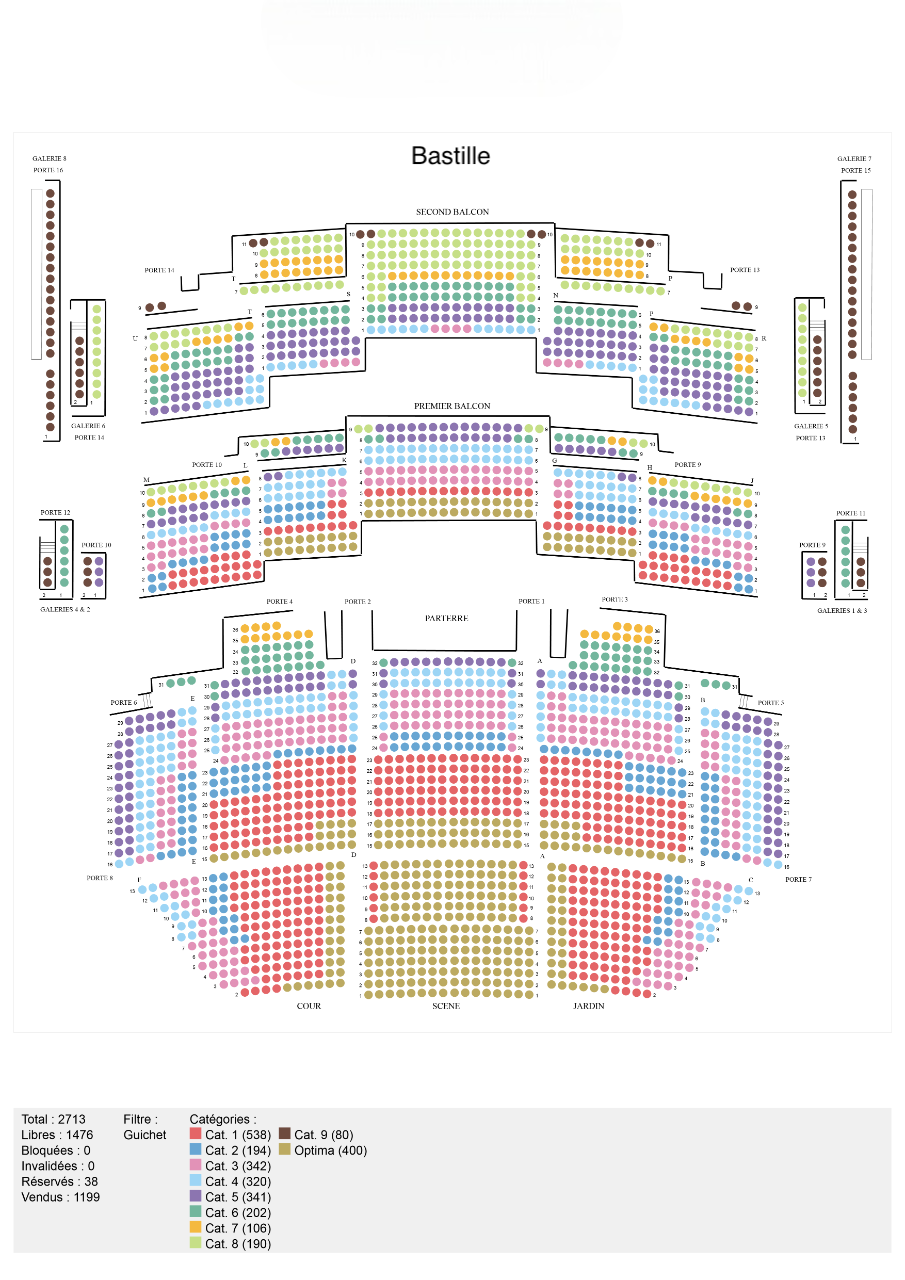
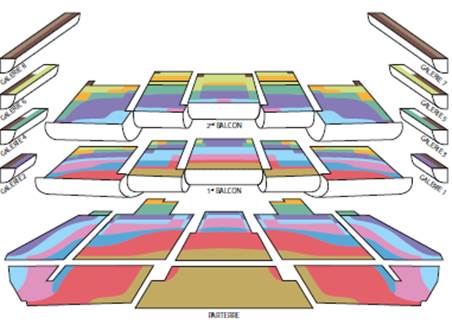
With its 2,700 acoustically consistent seats, its unique stage facilities, its integrated scenery, costume and accessory workshops, as well as its numerous work areas and rehearsal rooms, the Opera Bastille is a great modern theatre.
Stage facilities
Orchestra pit, mobile and adjustable, can be covered; at its largest it can house 130 musicians
Main stage, 45 m high, 30 m wide, 25 m deep, made up of 9 elevators allowing several levels to be created and supported by three main elevators, which bring scenery up from below stage
Clearing zones, 4 storage areas with the same dimensions as the stage
Backstage area, with its scenery turntable
Circulation area, scenery temporarily stored between the stage, workshops and rehearsal stage
Rehearsal stage, the Salle Gounod, with its orchestra pit and dimensions identical to those of the main stage
The building
Area at ground level: 22,000 m²
Floor area: 160,000 m²
Total height: 80 m (including 30 m below street level)
The auditoriums
The main auditorium
Area: 1,200 m², 5% of the total for the building
Dimensions: 20 m high, 32 m deep, 40 m wide
Number of seats: 2,703
Materials: blue granite from Lannelin in Brittany, pearwood from China, glass ceiling
The amphitheatre
Area: 700 m²
Depth : 21.4 m
Number of seats : 450
Materials: white breccia marble from Verona, staff ceiling
The Studio
Area: 280 m²
Depth: 19,5 m
Number of seats: 237
Materials: white breccia marble from Verona and pearwood

Related events